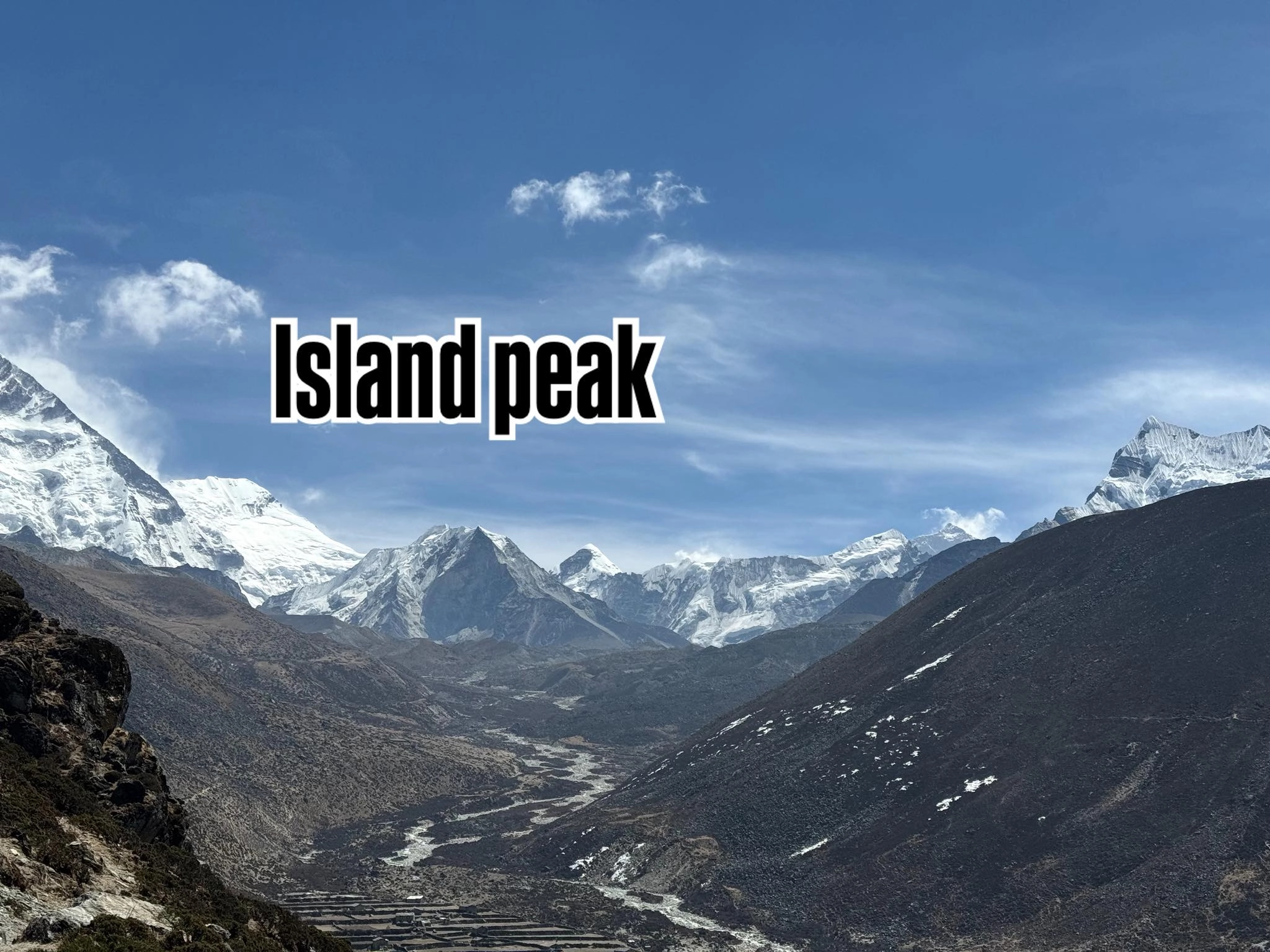
Island Peak Climbing
Trip Dossier
Trip Overview
Island Peak, formally known as Imja Tse, is one of the most famous and exhilarating "trekking peaks" in Nepal. Sitting at an elevation of 6,189 metres (20,305 feet), it offers an incredible mix of high-altitude trekking and entry-level alpine mountaineering. Named in 1953 by members of Eric Shipton’s British Mount Everest expedition because it resembles an island in a sea of ice when viewed from Dingboche, the peak remains a top bucket-list item for adventurers worldwide.
Trip Facts
Itinerary
Your Island Peak Trekking adventure begins as you check in for your international flight from Zurich, bound for Kathmandu, the vibrant capital of Nepal, nestled in a valley ringed by hills at the edge of the Himalayas. Depending on your routing, the journey may include a layover, giving you time to relax before nearly three weeks of remote high-altitude trekking ahead.
Accommodation: In-flight
Maximum Altitude: N/A
Arrive in Kathmandu and transfer to your 4-star hotel, where a member of our team will meet you and help you settle in after your flight. With the rest of the day free, take time to rest, meet your trekking guide, and review the journey ahead in detail. Given the technical and high-altitude nature of this trip, this is also an important opportunity to check your climbing equipment, confirm any last-minute gear requirements, and pick up remaining supplies from the trekking shops of the Thamel district before departure.
Accommodation: 4-Star Hotel, Kathmandu
Maximum Altitude: 1400M
Fly from Kathmandu or Ramechhap to Lukla *see note at bottom of itinerary. We will make an early morning start for the Twin Otter flight to Lukla (2,840m/9,317ft), the gateway to the Khumbu Region. This is an exciting flight, which should give a glimpse of Everest in the distance. In Lukla, we will meet the rest of our trek staff and set off straight away for our first night in the mountain village of Monjo. Depending on what time the flight arrives in Lukla, we may have to stop in the town of Phakding (2,600m/ 8,530 feet) for the night. Hopefully, the team will make it all the way to Monjo. Both villages are situated on the banks of the Dudh Kosi, which drains the whole of the Khumbu Region, and is the main trade route for the entire region. This can be the busiest part of the trail. Today we will walk for 3 hours to Phakding and a total of 5 hours to Monjo. The total distance is 8.8 miles/ 13 km from Lukla to Monjo.
Today we will continue up the banks of the Dudh Kosi River, towards Namche Bazaar. Just past Monjo, we will officially enter the Sagarmatha National Park before following the trail through small villages. We will take a tea break along the way. After tea, the trail then crosses the
confluence of the Dudh Kosi and the Bhote Kosi, on a high suspension bridge. The trail then climbs steeply uphill for about two hours to reach Namche Bazaar (3,440m/11,286 feet). This is a prosperous trading town and the capital of the Khumbu Region. Just across the valley to the east stand the peaks of Thamserku and Kangtega, both very impressive mountains. From Monjo, the trek today is approximately 4 hours, and the total distance is 5 miles/ 8 km.
Today is an acclimatization day where we will walk to the Sherpa Museum at 3,600m/ 11,811. From here you will have stunning views of Mount Everest and the surrounding mountains. The key is to rest, relax and acclimatize at this height and will make all the difference as we go to high and extreme altitude. The afternoon will be at leisure in Namche Bazaar, resting, eating, and enjoying the sites! Remember that it is still important to continue to drink 4-5 liters of water every day on the trail. Today, the walk up to the Sherpa Museum is only approximately 30 minutes.
Today we will leave Namche and trek to Tengbouche at 3,900m/ 12,800 feet. From Namche, the well-worn Everest trail contours around the side of the valley high above the Dudh Kosi. As we follow the path, we will get excellent views of the great peaks of the Khumbu; Everest, Lhotse, Nuptse and Ama Dablam. Passing by several villages, we will descend approximately 300m/ 984 feet down to the Dudh Kosi River, where we stop for lunch. After lunch, we will make the steep 700m/ 2,296 feet uphill climb to Tengbouche. This is the home of the impressive and famous Tengbouche Monastery. You can visit the Monastery or the local bakery this afternoon. The hike will be approximately 5 to 6 hours today and covers 7.5 miles/ 12 km.
We will continue up the trail to Dingbouche today. Shaded by Rhododendron trees, the trail crosses an airy suspension bridge just beyond Debouche. From here, the trail continues approximately an hour before reaching the village of Pangbouche. From here, there are excellent views of Ama Dablam ('Mother's Charm Box') and where we stop for tea. If there is time, we may be able to visit the local Monastery, which was the first in the Everest Region. Contouring up the valley, we will re-cross the river and turn up the Imja Valley to reach the picturesque farming village of Dingbouche at 4,350m/ 14,271 feet above sea level. The hike will take approximately 5 – 6 hours today and cover 7.5 miles/ 12 km.
Today is spent as another acclimatization day at this critical elevation. Just above the town, while on our acclimatization hike, we will have stunning views of three 8,000/ 26,200 feet peaks; Makalu, Cho Oyu and Lhotse. Our goal today is to ascend to 4,900m/ 16,000 feet for some of the most beautiful views on the trip. This is one of Ian’s favorite days of the trip! After enjoying the views and spending some time at this new elevation, we will descend back to Dingbouche for lunch. The afternoon will be free to enjoy the village of Dingbouche and relax before some more challenging days ahead. The trek today will be approximately 4 hours round trip and you will gain 550m/ 1,804 feet of elevation.
Today we will head to Chuckung at 4,700m/15,419 feet for our last night in a lodge for a few nights! Chuckung is a small settlement with some old and new larger lodges, where we spend the night. This is a 3-hour trek from Pheriche up to Chuckung. The first part of the trek is a steep ascent up a hill, followed by more gradual terrain, all the way into Chuckung. We will pass Dingbouche, where we spent two nights on the way up to Base Camp! On arrival, after a nice lunch, you will go through all climbing equipment and do some training in the afternoon. You will make sure your harness, crampons, Jumar, and all climbing equipment fits and is ready to use.
We will wake up this morning, have breakfast and once all the gear is loaded on the animals, we will make our way to Island Peak Base Camp at 5,100m/16,732 feet. We will follow the glacial moraine up out of Chuckung, before moving down toward the runoff from the Imja Lake. The trail weaves between small hills before coming out onto a flat sand plain, right in front of Island Peak and Lhotse. From here, we walk around the right-hand side of Island Peak, which leads directly into Island Peak Base Camp. The amazing views of the entire Imja Valley surround us throughout the hike today! It will take us approximately 3 hours trekking to reach Island Peak Base Camp. If time allows this afternoon and the weather is good, then we will spend a bit more time training today, in preparations for moving higher on the mountain.
Today is spent in Island Peak Base Camp, doing extra training on steeper terrain, and making sure you are fully comfortable with your climbing equipment. We will spend the morning (or as much time as needed) training and doing final gear checks. Now it is time to rehydrate, eat, relax, and try to get a good night’s sleep!
We will be moving on to High Camp on Island Peak at 5,500m/18,044 feet. We will rest in Base Camp for the morning, pack up, and have lunch before moving higher. The initial hike takes us past the Imja Glacier and Lake, before we turn steeply uphill for approximately two hours. The trek into High Camp takes about 2 hours. You will now need to rest and rehydrate before leaving on the summit attempt the following morning.
Today is planned as our summit attempt on Island Peak 6,189m/20,305 feet, however this may be changed due to weather conditions. You will have to be flexible and listen to the guides as they will decide based on the weather. We will aim to leave at 2am, as this is a long hard climb and we will need to pace ourselves for a long day. We first hit rocky scree for 150m/492 feet before a scramble and traverse across to a steeper section of rock. This is a mixture of trekking and scrambling and is very strenuous. Once you hit 5,700m/18,700 feet the altitude slows the pace dramatically and the final steep rock section never seems to end. Once you dig deep, we top out onto a narrow ridge which takes us to the start of the glacier and crampon point. At crampon point, we will put on our harness and crampons, get out our ice axe and rope up to climb across the glacier. From here, we make our way across the glacier. Depending on the conditions, there could be ladder crossings, steep climbing sections up and down and large crevasses to cross. This can take us approximately anywhere from 1 – 2 hours to reach the base of the Headwall, depending on conditions. Once we reach the Headwall, we will take a break as our Sherpa team get to work setting the route. Our expert Sherpa team will fix our own climbing rope up the Headwall to ensure the route up the 150m/ 492 feet section, on a 50-65-degree angle, is set up safely. After the strenuous climb up the Headwall, you will reach the summit of Island Peak! The views off the summit are nothing short of spectacular! The summit is very small, and you always need to remain clipped into the rope. After you have enjoyed the views and taken all the pictures you can, we will then prepare to head back down the Headwall. The abseil down the Headwall needs to be done in a controlled manner, so that we can move quickly as a team off the glacier. This is why you need to be fully prepared and trained to abseil on a fixed line safely. Once off the Headwall, we will rope back up and retrace our steps through the glacier, back to crampon point. From here, we can take off our climbing equipment and continue down the trail back to High Camp. Once we reach Camp, we will take a short rest, pack up our gear and move lower down the trail for one hour, to Base Camp for a meal. If time allows, then we will continue further down the trail to Chuckung, which takes approximately 2 hours. Once in Chuckung, we will enjoy a warm meal and quickly head to our well-deserved night of sleep in our beds.
After a great night’s sleep and a hearty breakfast, we will start to hike back down the trail. From Chuckung, it will take approximately one hour to reach Dingbouche, before we follow the main Everest trail back through Shomare and Pangbouche. After Pangbouche, we will cross the river before heading back uphill into Tengbouche for the night. If you feel up for it you can visit the Monastery or the local bakery, otherwise another good night’s sleep will help you recover and prepare for another long day tomorrow. The total trek today is approximately 4 – 5 hours.
From Tengbouche, the trail continues downhill for one hour, until we reach the river. From here, there is a one hour and thirty-minute ascent, back up to the Ama Dablam View Guesthouse, where we will have a short tea break. There is another approximately hour and thirty minutes before we reach Namche Bazaar by lunchtime. This hike should take 4 hours.
Today is the final day of trekking!! It will be another long day as we must get all the way back to Lukla for the night. The day starts with a one-hour descent from Namche, back to the high suspension bridge. Following the river from here, you will have to trek up and down stairs and trails, retracing our steps back to Phakding, where we will stop for lunch. After lunch, it will be a gradual two-and-a-half-hour ascent back into Lukla at 2,850m/ 9,350 feet. The hike today will take approximately 8 hours, and we will not reach Lukla until late afternoon. The distance covered today is 13 miles/ 21 km and you will enjoy your final night spent in the Everest Region tonight.
We will wake early today and have breakfast before returning to Lukla Airport for the flight back to Ramechhap or Kathmandu*. If the weather is cooperating, and the flight is direct to Kathmandu, then you would be back in the hotel in Kathmandu by early morning! If you must fly via Ramechhap, then you might not be in Kathmandu until late afternoon. You can spend the rest of your day at Leisure in Kathmandu, enjoying the sites, including Pashupatinath, Swayambhunath and the districts of Bhaktapur and Patan. Durbar Square is also on the essential list, as is the shopping area of Thamel or get a treatment at one of the many spas in Kathmandu. We include a celebration team dinner in a nearby restaurant and the night in the hotel is also included on a shared basis.
Transfer to Tribhuvan International Airport in good time for your international flight home, bringing to a close an extraordinary journey to the summit of Island Peak and through the remote wilderness of the Hinku Valley.
Arrive back in Zurich, marking the end of your Island Peak Trekking adventure, with the memory of standing atop one of the world's great viewpoints, surrounded by five of the highest mountains on Earth, staying with you long after the journey ends.
What's Included
- International flights: Zurich – Kathmandu – Zurich
- Airport transfers in Kathmandu (arrival and departure)
- 2 nights 4-star hotel accommodation in Kathmandu (Bed & Breakfast basis)
- Flight Kathmandu - Lukla
- Return transfer: Lukla–Ramechhap–Kathmandu (flight and/or shared vehicle, depending on season)
- All teahouse/guesthouse accommodation during the lower-altitude trekking days
- Tented camp accommodation with full board at Island Peak Base Camp and (High Camp)
- NMA (Nepal Mountaineering Association) Island Peak Climbing Permit
- Makalu Barun National Park Entry Permit
- Local area permit for the Hinku Valley/Solukhumbu region
- Experienced, licensed trekking guide with mountaineering training, plus climbing Sherpa support for summit day
- Porter service (based on group size)
- Group climbing equipment (ropes, ice screws, and other technical gear for the summit ascent)
- All applicable government and local taxes
What's Excluded
- Nepal entry visa fee
- Specialized mountaineering travel and emergency evacuation insurance covering altitudes above 6,000 m (mandatory; standard trekking insurance is not sufficient)
- Personal climbing gear, including crampons, ice axe, harness, and helmet
- Personal trekking gear and equipment
- NMA garbage deposit (refundable upon proof of waste management)
- Tips for guide, climbing Sherpa, and porters
- Personal expenses such as Alcoholic Beverages
- Any costs arising from flight delays or cancellations to/from Lukla or Ramechhap due to weather, or other itinerary changes beyond our control
Fixed Departures
Oct 01, 2027 - Oct 19, 2027
CHF 4500.00 /Person